
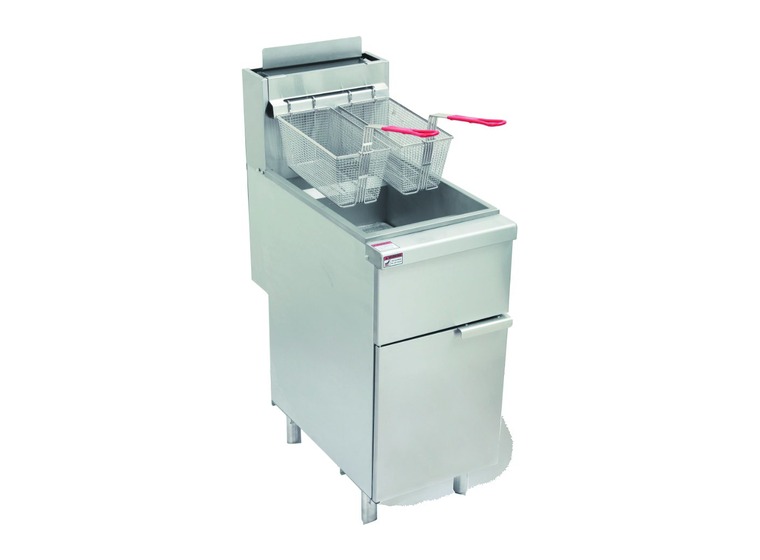
Direct answer: which fryer configuration is better?
A single-tank commercial fryer is usually the better choice for a focused menu, limited counter space, moderate demand and lower oil consumption. A double-tank fryer is better when a kitchen must separate two food categories, operate at different temperatures, increase menu flexibility or keep one side available while the other is filtered or cleaned.
Tank count alone does not determine output. The correct choice depends on real basket load, heating power, oil volume, temperature recovery, cooking time, peak portions per hour, electrical supply and staff workflow. Compare the complete operating system, not only the number of tanks.
Quick comparison: single tank vs double tank fryer
| Selection point | Single-tank fryer | Double-tank fryer |
|---|---|---|
| Best use | Focused menu and one main frying temperature. | Two food groups, two temperatures or greater service flexibility. |
| Counter space | Usually smaller and easier to place. | Usually wider and needs more service clearance. |
| Oil requirement | Lower total oil volume for one active tank. | More oil when both tanks are filled; one side may be switched off if independently controlled. |
| Flavor separation | All products share the same oil. | Independent tanks can reduce flavor transfer. |
| Temperature settings | One operating temperature at a time. | Two temperatures when each tank has independent controls. |
| Electrical load | Usually lower total rated power. | Usually higher when both tanks heat at the same time. |
| Cleaning | One tank, basket and heating zone to clean. | Two tanks and two heating zones require more labor. |
| Initial cost | Normally lower. | Normally higher, but may replace two separate machines. |
| Downtime flexibility | The whole frying station stops if the unit is unavailable. | One independent tank may remain available while the other is serviced, depending on design. |
When a single-tank commercial fryer makes sense
A single fryer works well when most orders use the same product family and cooking temperature. Examples include a small fries counter, compact snack shop, food stall, cafe with one fried side dish or a start-up testing demand before expanding.
- The menu has one main fried product or compatible products.
- Peak demand fits one tested basket and recovery cycle.
- Counter width and electrical capacity are limited.
- The operator wants a simpler oil, cleaning and spare-parts routine.
- The business prefers lower initial investment and less idle oil.
The risk is dependence on one oil zone. Products can transfer flavor, and the kitchen cannot run two temperature settings at the same time. If the fryer is being filtered, cleaned or repaired, there is no second tank to continue production.
When a double-tank commercial fryer is worth the investment
A double-tank fryer is useful when each tank can operate independently and the menu benefits from separation. One side might cook fries while the other handles breaded snacks, or one side might run at a different temperature for dough products. During a slower period, an operator may use only one side if the machine and controls allow independent operation.
- Two food categories should not share the same oil.
- Products require different cooking temperatures.
- Peak demand requires parallel production.
- One tank must remain available during filtering or cleaning.
- The additional oil, power, counter space and labor are justified by sales.
Confirm that “double tank” means two separate oil tanks with separate controls and heating systems. Some product descriptions use “double basket” for two baskets placed in one large tank, which does not provide oil or temperature separation.
Double tank is not the same as double basket
| Configuration | Oil zones | Temperature control | Typical advantage |
|---|---|---|---|
| Single tank, single basket | One | One setting | Simple operation and focused batches. |
| Single tank, two baskets | One shared oil zone | One setting | Two smaller batches can be lifted at different times. |
| Double independent tanks | Two separate oil zones | Two settings when independently controlled | Food and temperature separation. |
| Two separate single fryers | Two separate oil zones | Two independent settings | Flexible placement and replacement. |
Ask for tank drawings, basket dimensions, control-panel photos and a wiring diagram. The quotation should state the capacity of each tank rather than only a combined total.
How to compare real production output
A double-tank fryer does not automatically produce twice as much food. Output is limited by food load, oil-to-food ratio, heating power, thermostat behavior, recovery time, cooking time, draining space and operator speed. Calculate performance with the food and portion that will actually be sold.
- Set the target portions required during the busiest 15 minutes.
- Define the real food weight per basket without overloading.
- Measure cooking time and temperature recovery after each load.
- Run repeated batches on one tank and then on both tanks.
- Record completed portions, product quality and electrical demand.
If staff cannot load, drain, season and pack two baskets efficiently, the theoretical extra capacity may not become completed orders. The fryer station must be designed with landing space and food holding where required.
Power and electrical planning
Two independently heated tanks generally create a larger connected electrical load. Confirm the rated power of each tank, the total power when both operate, voltage, frequency, phase, current, plug type and whether the machine uses one or two power supplies. A familiar plug appearance is not proof that the fryer suits the site.
Send the full equipment schedule to a qualified local electrician before ordering. The fryer may share a kitchen with griddles, warmers, refrigeration and other machines that operate during the same peak period. Review the commercial kitchen equipment voltage and plug guide for the information to confirm.
Oil cost and menu separation
A single tank normally ties up less oil, which can help a low-volume operation maintain a practical filtering and replacement schedule. A double fryer requires oil in both tanks when both sides are used. However, separate tanks can protect product quality by reducing flavor transfer and can allow one side to remain off when demand is low.
Calculate oil cost from usable operating level, top-up frequency, filtering, replacement schedule and disposal—not only tank capacity. Food type, coating, moisture, crumb load and operating temperature all influence oil life.
Food separation does not automatically solve allergen control
Separate tanks can reduce direct cross-contact between food cooked in different oil, but allergen control also depends on baskets, utensils, preparation surfaces, storage, staff procedures and local regulations. Do not market a product as allergen-free based only on using a double-tank fryer. Build and verify a complete food-safety procedure with qualified local guidance.
Cleaning and maintenance comparison
A single fryer has fewer tanks, baskets, heating zones and controls to clean and inspect. A double fryer doubles many daily tasks. Before purchasing, check whether heating assemblies lift safely, crumbs can be removed from tank corners, baskets are replaceable and electrical areas are protected from cleaning water.
| Maintenance point | Single tank | Double tank |
|---|---|---|
| Daily cleaning | One oil zone and control area. | Two oil zones and more surfaces. |
| Spare baskets | One primary basket type. | Confirm basket interchangeability and quantity. |
| Heating and thermostat parts | One active system. | Two systems may increase spare-parts requirements. |
| Service continuity | No backup tank within the machine. | Independent second side may continue operating if safe and permitted. |
One double fryer vs two separate single fryers
An integrated double fryer can provide a cleaner equipment line and a combined housing. Two separate single fryers provide more freedom to position, replace or move each unit. They can also reduce the risk that one shared structural or electrical fault removes both tanks from service.
Compare the exact footprint, power connections, service access, packing volume, purchase cost and spare-parts strategy. For importers, ask whether the single and double models share thermostats, baskets, heaters or other service parts.
Example: Sunchef compact single-tank fryer
Sunchef model HT-81 is a catalog-listed single-tank countertop electric fryer with a 6-liter capacity. The 2026 catalog lists rated power of 2.5 kW, 110 V or 220 V at 50-60 Hz, and overall dimensions of 285 × 450 × 310 mm.
This model is a useful reference for focused snack shops, cafes and small restaurant kitchens. Buyers needing two oil zones should send the two menus, target portions per hour, available counter width and electrical supply so Ben can compare suitable configurations. Buyers planning a larger restaurant line can also review the countertop vs floor-standing fryer guide. Always confirm the current specification sheet and final production version.
Decision checklist for restaurant buyers
- How many food categories must be fried?
- Must flavors, temperatures or oils remain separate?
- What are the peak portions per 15 minutes?
- What basket load and recovery have been tested?
- Can the site support the total power when all tanks operate?
- How much counter space and service clearance are available?
- What is the total oil cost for the planned operating schedule?
- Can staff clean and maintain two tanks correctly?
- Would two separate single fryers reduce downtime risk?
Checklist for importers and distributors
- Exact model number and clear tank-versus-basket description.
- Capacity per tank and recommended operating oil level.
- Basket dimensions and recommended food load.
- Power per tank, total power, voltage, frequency, phase and plug.
- Independent controls, thermostats and high-limit protection.
- Machine dimensions, packing dimensions and gross weight.
- Material specification, cleaning method and drain arrangement where provided.
- Model-specific certification scope, labels and instructions.
- Warranty, wiring diagram and common spare-parts list.
Frequently asked questions
Is a single-tank or double-tank commercial fryer better?
A single-tank fryer is usually better for a focused menu, limited space and lower oil use. A double-tank fryer is better when two foods need separation, different temperatures or independent production during busy service.
Can I cook two different foods in a double-tank fryer?
Yes, when the tanks are truly independent. Separate oil helps reduce flavor transfer and allows different temperatures, but allergen control still requires a complete operating procedure and local food-safety review.
Does a double-tank fryer always produce twice as much food?
No. Output depends on basket load, heating power, oil volume, temperature recovery, cooking time and operator workflow. Compare tested portions per hour rather than tank count alone.
Does a double-tank fryer need more electrical power?
Usually yes when both tanks heat independently. Confirm total rated power, whether each side has a separate supply, and the circuit requirements with the supplier and a qualified local electrician.
Which fryer uses less oil?
A correctly sized single-tank fryer normally requires less total oil than operating two tanks. A double fryer can save oil when only one side is switched on during slow periods, if the model supports independent operation.
Is one double fryer better than two separate single fryers?
An integrated double fryer can simplify placement, while two separate units offer flexible positioning and independent replacement. Compare footprint, power connections, cleaning, service access and downtime risk.
Ask Ben to compare single and double fryer options
Send your menu, food categories, portion size, target hourly output, counter dimensions, destination country, voltage and quantity. Sunchef will recommend a suitable fryer configuration and confirm current specifications.